Cross Charge or ISD – Are You Using the Right Mechanism?
If you’re running a business with multiple branches or offices across India, assessing the complexities of Goods and Services Tax can often feel like solving a puzzle. One of the most debated questions? Whether to opt for GST cross charge or the Input Service Distributor (ISD) mechanism. Both serve the purpose of distributing input tax credit, but their application and implications are quite different.
So, how do you determine which mechanism best suits your business?

Cross Charge vs ISD Under GST: Essential Concepts
ISD under GST refers to a mechanism where a head office (HO) distributes the input tax credit (ITC) it receives on standard input services to its different units or branches. These units must be under the same PAN but located in other states. The HO issues an ISD invoice to allocate the ITC proportionately.
GST cross charge, on the other hand, comes into play when the HO or any unit provides a service (even if not invoiced) to another unit of the same company. In such cases, the supplying unit must raise a tax invoice and pay GST on the value of the service that has been transferred.
When Should You Use ISD?
Use ISD if:
Your HO receives invoices for services like audit, consulting, advertising, or HR support that are used by multiple branches.
You want to distribute ITC without raising tax invoices.
You want to simplify compliance by filing only the ISD return (GSTR-6).
According to the CBIC guidelines, ISD is purely for credit distribution and not for the supply of services.
When Is Cross Charge More Appropriate?
Use GST cross charge if:
There’s an actual or deemed supply of services between branches, such as IT support provided by the HO to another unit.
Employees at the HO work for another branch, and their salary cost is recharged.
The branch receiving the service is located in a different state, triggering an interstate supply.
The cross charge involves tax invoicing and can be more documentation-intensive. However, it ensures proper valuation and taxability under the GST law.
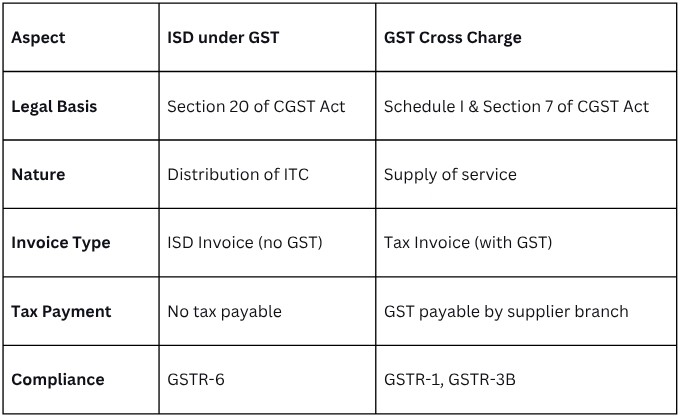
Key Differences: Input Service Distributor vs Cross Charge
Common Mistakes to Avoid
- Using ISD for cross charging: This can lead to compliance errors and penalties.
- Wrong valuation: Under cross charge, value must be determined per Rule 28 of the CGST Rules.
- Not registering as ISD: If using the ISD mechanism, registration as ISD is mandatory.
Which Should You Choose?
The answer depends on the nature of the transaction. If it’s about sharing credit on standard input services, go for ISD. If it’s about the provision of internal services between branches, cross charge is the way.
Many businesses use a hybrid approach, employing ISD for credits and cross charge for internal service supply. But this must be clearly documented and aligned with your GST filings.
Choosing between GST cross charge and ISD under GST is not just a compliance issue but a strategic decision. Incorrect classification can result in mismatched credits, penalties, and audits.
When in doubt, consult a tax professional to help evaluate your business activities and design the right approach. Solving the GST puzzle now can save you a lot of trouble later.