India’s startup ecosystem is entering a new phase, one in which ambition is being matched by stronger digital-compliance expectations. Over the past year, regulators have tightened data-governance rules and streamlined self-certification processes, signalling that India wants a startup economy that can scale responsibly and attract credible global capital. For overseas investors, this shift doesn’t add friction; it offers clarity. The rules are more straightforward, the risks are more measurable, and the path to market is far more predictable than it was even two years ago.
What changed: the headlines
- The Digital Personal Data Protection framework is now in place, setting clear obligations for data collection, retention and cross-border transfers. Compliance is no longer optional for startups operating online.
- Startup India formalises online self-certification for labour and environmental laws, speeding up compliance but requiring disciplined record-keeping.
Why this matters to overseas investors
- Regulatory clarity reduces tail risk. Clear data rules mean predictable obligations for user data and transfers.
- Faster onboarding and fewer surprise inspections. Self-certification limits routine inspections for eligible startups, applicable when planning rapid pilots.
- Valuation and exit readiness. Startups that embed compliance early command higher valuations and smoother due diligence cycles.
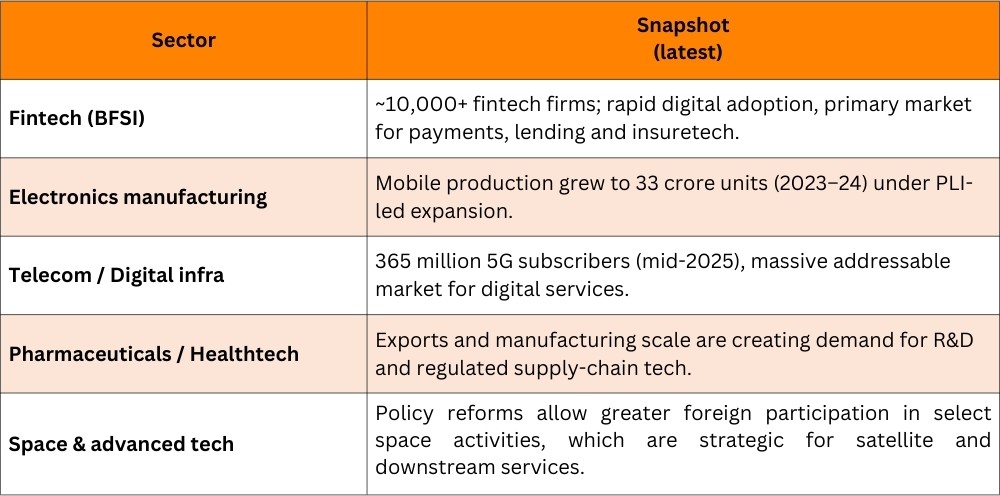
Key sectors gaining traction
Below is a concise table with recent traction metrics investors should watch.
Practical checklist for investors
- Confirm the startup’s data-governance framework (privacy policy, DPIA, cross-border rules).
- Verify self-certification records under Startup India and related state approvals.
- Run a focused tech and regulatory due diligence on sector-specific rules, telecom, healthtech, and fintech, which have extra licensing.
- Factor in PLI/state incentives and location economics for manufacturing or contract-manufacturing plays.
India’s regulatory environment isn’t tightening to slow innovation but maturing to support it. The new digital and compliance frameworks are designed to separate long-term, investment-ready businesses from short-lived experiments. Startups that embed compliance into their operating rhythm now will scale faster, raise capital on better terms, and move through investor due diligence with far fewer surprises.
For global investors evaluating India, this shift should be seen as an advantage rather than an obstacle. More explicit rules mean more precise risk assessment, predictable timelines, and a more disciplined ecosystem for deploying capital. The country’s most active sectors, from fintech and electronics to pharmaceuticals and space tech, are already benefiting from this structured approach.
If India is on your expansion radar, this is the moment to act. Connect with Walmond Consultancy LLP for a sector-specific assessment or a customised entry roadmap, and move forward with the confidence of a partner who understands the terrain end-to-end.